Tuesday, January 13, 2009

Iris ensata "Wind Drift"


Early / Mid Season Japanese Iris.

Iris ensata
"Wind Drift"


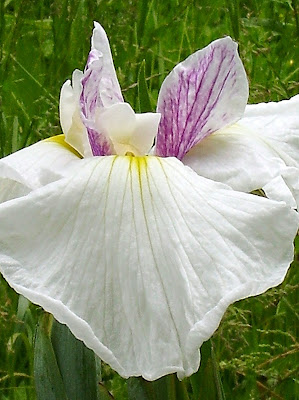
This Japanese iris grows well in a garden and can withstand a more dry and shady position. It produces tall stems of truly beautiful flowers which look like large white butterflies fluttering in the breeze in early to mid season. The clean white stands out in a garden display with it's spectacular 3 petal slightly ruffled form of Iris ensata " Wind Drift".


The colour is very beautiful.

A clean white lightly ruffled petals with a small yellow signal. White, variably marbled light to heavy veins of red - violet standards. Very delicate in it's flower pres
entation.


Excellent pollen producer which I have used to some of my hybridizing program.


The plant grows really well for me with lots of beautiful clean foliage and tall ram rod stems held proudly above the upright arching foliage.
It produces an abundance of flowering stems on a well formed stunning clump in late November / early December.

This variety was created by A. Vogt and introduced by H. Stahley in 1983, registered from seedling 812. Introduced by H. Stahley in 1984.


It grows to a height of 90 cms (36 ins) and flowers early to mid season in New Zealand and world wide.


This beautiful variety looks magic planted up to be enjoyed in the garden near your pond or any rich moist soil.


Remember to give it at least 6 hours of sun light if you can. Japanese irises are gross feeders so a good balance fertilizer in the early spring and again after flowering around the drip line of foliage will do them proud. Little and often is a good rule of thumb for fertilizers. Water in where possible to help the plant take up the benefits.


Mulch around the plants with barely straw, pine needles or pea straw to retain moisture in soil and prevent weed growth.


Remember that Japanese Irises "Love wet toes and dry ankles" so when you are planting these take this into consideration
please.

Available in New Zealand and around the world.


* Acknowledgement: - 2003 Cumulative Check list of the Japanese Irises complied for The Society of Japanese Irises.

Monday, January 12, 2009

Iris ensata "Iapetus"


Early / Mid Season
Japanese Iris
.

Iris ensata " Iapetus"


This Japanese iris is stunning and produces tall stems of truly beautiful flowers in mid season. It stands out in a garden display with it's spectacular 6 petal ruffled form of Iris ensata " Iapetus".


The colour is stunning. A beautiful rich wide ruffled light ground, sanded and veined deep blue - violet; blue -violet halo, deep red violet styles. Dark rich in colour when the young flower buds open and once in full bloom the sun fades it out to softer exciting colours which illuminates in the evening light. Shows signs of branching producing extra flower buds.


Excellent pollen pro
ducer and pod parent for cross pollination and production of seed. Some exciting crosses and exciting new varieties have been successfully introduced all over the world from this variety. A great hybridizers doorway to the unknown.


The plant grows really well for me with lots of beautiful clean foliage and tall ram rod stems held proudly above the upright arching foliage. It produces an abundance of flowering stems on a well formed stunning clump in late November / early December.

This variety was cre
ated and selected by Sterling Innerst in Southern PA/ Maryland. USA., registered and introduced in 1987 from seedling 928-1. It was called HORAE but this changed with registration in 1987.
928-1 is crossed with: (Narihira x Valiant Prince) X Frostbound. Introduced by Ensata Gardens in 1988.


"Iapetus" was awarded an Honorable Mention (HM) for its plant growth habit and flowering in 1990, then
gained a Award of Merit (AM) in 1994 after its introduction. Success in its growing habit and flowering in a garden took "Iapetus" to win the prestigious Payne Medal. The highest award possible for a Japanese iris in 1997. Awarded by The Society of Japanese Irises.


It grows to a height of 86 cms (34 ins) and flowers early to mid season in New Zealand while flowering in the mid season else where in the world.

This beautiful variety looks magic planted up to be enjoyed in the garden near your pond or any rich moist soil.


Remember to give it at l
east 6 hours of sun light if you can.


Japan
ese irises are gross feeders so a good balance fertilizer in the early spring and again after flowering around the drip line of foliage will do them proud. Little and often is a good rule of thumb for fertilizers. Water in where possible to help the plant take up the benefits. Mulch around the plants with barely straw, pine needles or pea straw to retain moisture in soil and prevent weed growth.


Remember that Japanese Irises "Love wet toes and dry ankles" so when you are planting these take this into consideration please.


Available in New Zealand and around the world.


* Acknowledgement: - 2003 Cumulative Check list of the Japanese Irises complied for The Society of Japanese Irises.

P.S. Did you know that if you click on the photo it will enlarge for you.

Monday, December 1, 2008

Iris ensata "Pink Dimity"

Early / Mid Season Japanese Iris.


Iris ensata " Pink Dimity"


This is a stunning Japanese iris that flowers in my garden. It is another spectacular 6 petal form of
Iris ensata " Pink Dimity".


The colour is stunning. A beautiful lightly ruffled rich vibrant pin
k. (RHS 55D) ground, veined light maroon (74B), mauve (74C), halo around gold signal, mauve (74C) stylearms. The plant grows really well for me with lots of beautiful clean foliage and tall ram rod stems held proudly above the upright arching foliage. It produces an abundance of flowering stems on a well formed stunning clump in late November / early December.


This was created and selected by Lorena Reid and registered by her in 1987 from her seedling D658-7. Cross with Valiant Prince X Marx MX 4, introduced by Laurie's Garden 1987.


"Pink Dimity" was awarded an Honorable Mention (HM) for its plant growth habit and flowering in 1989 and a Award of Merit (AM) in 1994 after its introduction.

It grows to height of 91 cms (36 ins) and flow
ers early to mid season in New Zealand while flowering in the mid season else where in the world.


This beautiful variety looks magic planted up in drifts of 10 to 15 or more plants to be enjoyed in the garden near your pond or any rich moist soil. Makes a stunning display when in full flower. Just unreal in it's colours giving an amazing effect.


Remember to give it at least 6 hours of sun light if you can. Japanese irises are gross feeders so a good balance fertilizer in the early spring and again after flowering around the drip line of foliage will do them proud. Little and often is a good rule of thumb for fertilizers.

Water in where possible to help the plant take up the benefits. Mulch around the plants with
barely straw, pine needles or pea straw to retain moisture in soil and prevent weed growth.


Remember that Japanese Irises "Love wet toes and dry ankles" so when you are planting these take this into consideration please.


Available in New Zeal
and and around the world.


* Acknowledgement: - 2003 Cumulative Check list of the Japanese Irises complied for The Society of Japanese Irises.

Sunday, November 30, 2008

Iris ensata " Lavender Sashay"


Early / Mid Season Japanese Iris.

Iris ensata
" Lavender Sashay"


Another of my early Japanese iris flowers to appear in my garden is another spectacular 6 petal form of Iris ensata " "Lavender Sashay".


The colour is soft lavender pink with prominent blue halo around a yellow signal, White styles edged with lavender fringe. Flowering in mid to late season in the USA. The plant grows well for me with lots of beautiful clean foliage and tall ram rod stems held proudly above the upright arching foliage. It produces an abundance of flowe
ring stems on a well formed clump in New Zealand in late November / early December.


This was created by Walter Marx and selected by A. Rogers and registered from the seedling WM M07.


"Lavender Sashay" was awarded an Honorable Mention (HM) for its plant growth habit and flowering in 1986 after its introduction in 1983. It grows to height of 122 cm ( 48 ins) and flowers early to mid season in New Zealand while flowering in the mid to late season else where in the world.


This beautiful variety looks magic planted up to be enjoyed in the garden near your pond or any rich moist soil.
Remember to give it at least 6 hours of sun light if you can.

Jap
anese irises are gross feeders so a good balance fertilizer in the early spring and again after flowering around the drip line of foliage will do them proud. Little and often is a good rule of thumb for fertilizers.


Water in where possible to help the plant take up the benefits. Mulch around the plants with barely straw, pine needles or pea straw to retain moisture in soil and prevent
weed growth.


Remember that Japanese Irises "Love wet toes and dry ankles" so when you are planting these take this into consideration please.


Available in New Zealand and around the world.


* Acknowledgement
- 2003 Cumulative Check list of the Japanese Irises complied for The Society of Japanese Irises.

Friday, November 28, 2008

Iris ensata "McKenzie Sunset"

Early / Mid Season Japanese Iris.


Iris ensata
" McKenzie Sunset"


From my early Japanese iris flowers to appear in my garden is another spectacular 6 petal form of Iris ensata " McKenzie Sunset".


The colour is soft and in the garden with fluted and ruffled violet, white area around greenish gold signals with white rays extended outward, white style arms tipped violet. The plant grows well for me with lots of beautiful clean foliage and tall ram rod stems held proudly above the upright arching foliage. It produces an abundance of flowering stems on a well formed clump in late November / early December.


This was created and selected by Lorena Reid and registered by her in 1988 from her seedling D552-5. A116-5: (maroon seedling x white seedling) X Mystic Buddha , introduced by Laurie's Garden 1989.


Judging of Japanese irises is done by garden judging and evaluation of seedlings on the show bench or growing in gardens around the United States and in other countries around the world. The judging is governed by rules and standards of the American Iris Society and The Society for Japanese Irises. Other countries have adopted these rules and standards in their Iris Societies and where needed have made slight changes to allow for the conditions in each country while still applying a very high standards for awards given to Irises. In giving awards to hybridizers a seedling becomes eligible for it first award as a seedling before it is introduced to the commercial sector of the garden industry. This award is called a High Commendation (HC).


Once a seedling is introduced it then become eligible on its second year after its introduction to the commercial garden industry for a Honorable Mention (HM). For year 2 to year 4 it is eligible for the Payne Award (Awarded in the USA). While in other countries around the world, the irises that is introduced in that country is placed in a series of test gardens for evaluation and is eligible for a Dykes Medal if the irises meets outstanding standards set for this award.


McKenzie Sunset was awarded an Honorable Mention (HM) for its plant growth habit and flowering in 1991 after its introduction. It grows to height of 85 to 105 cms (34 to 42 ins) and flowers early to mid season in New Zealand while flowering in the mid season else where in the world.
This beautiful variety looks magic planted up to be enjoyed in the garden near your pond or any rich moist soil.

Remember to give it at least 6 hours of sun light if you can.

Japanese irises are gross feeders so a good balance fertilizer in the early spring and again after flowering around the drip line of foliage will do them proud. Little and often is a good rule of thumb for fertilizers.

Water in where possible to help the plant take up the benefits. Mulch around the plants with barely straw, pine needles or pea straw to retain moisture in soil and prevent weed growth.

Remember that Japanese Irises "Love wet toes and dry ankles" so when you are planting these take this into consideration please.

Available in New Zealand and around the world.


* Acknowledgement: - 2003 Cumulative Check list of the Japanese Irises complied for The Society of Japanese Irises.

Monday, November 24, 2008

Iris ensata " Good Omen"

Early / Mid Season Japanese Iris.


Iris ensata " Good Omen"

The first Japanese iris flower to appear in my garden is a spectacular 6 petal form of Iris ensata " Good Omen".


The colour stands out in a garden with a deep rich wine self, dark halo, long bright yellow signal spears which radiates from the centre of the flower.


The plant grows well for me with lots of beautiful clean foliage and tall ram rod stems held proudly above the upright arching foliage. It produces an abundance of flowering stems on a well formed clump in late November / early December.


This was selected from the Carmen series by Walter Marx and registered by him in 1956 from his seedling 56-151. It grows to height of 91 cms (36 ins) and flowers early to mid season in New Zealand while flowering in the mid season else where in the world.


An outstanding variety to grow and looks magic planted up in a group planting of 10 or more plants in a drift to be enjoyed in the garden near your pond or any rich moist soil.


Remember to give it at least 6 hours of sun light if you can. Japanese irises are gross feeders so a good balance fertilizer in the early spring and again after flowering around the drip line of
foliage will do them proud. Little and often is a good rule of thumb for fertilizers.


Water in where possible to help the plant take up the benefits. Mulch around the plants with barely straw, pine needles or pea straw to retain moisture in soil and prevent weed growth.


Remember that Japanese Irises "Love wet toes a
nd dry ankles" so when you are planting these take this into consideration please.


Available in New Zealand and around the world.


* Acknowledgement
:
- 2003 Cumulative Check list of the Japanese Irises complied for The Society of Japanese Irises.

Sunday, November 23, 2008

Great Japanese Iris hybridizers of the Past..


Walter Marx.

A tribute to one of the worlds most outstanding hybridizers noted for his dedicated work towards the advancement of Peonies and Japanese Iris (Iris ensata). This nurseryman was a leader of his time setting a bench standard and inspiration to hybridizers' young and old a like of which many of his wonderful varieties of Japanese irises are in all corners of the globe and still widely propagated in nurseries today.

Walter, along with his wife Louise Marx lived in Boring, Oregon in the United States and had one of the largest perennial nurseries in the US. He become interested in all types of Irises. Walter's interest in the Japanese iris was so strong that in 1937 he ordered a collection of Japanese irises from Japan. These beautiful flowering plants inspired him to want to begin a breeding program to create more incredible varieties. He set to the task and began to hybridize them with great success in the results of his crosses. He was convinced that the Higo strains gave the best results for his work and began in earnest with his hybridizing program in Japanese Irises using these varieties.They therefore where called the Marhigo strain.


The first of his creations where listed in his nursery catalogue in 1953. He produced over a hundred more hybrids up till the late 1960's.


Here is a beautiful picture from his Walter Marx Nursery catalogue which he produced in full colour to popularize the Japanese Iris to encourage the purchase of these new varieties which flowered so well for him and he wanted to share his work with keen gardeners and the rest of the world.


His most popular varieties produced where " Blue Lagoon", "Frilled Enchantment", " Frosted Pyramid", "Gay Gallant", "Snowy Hills", "Summer Storm", "World's Delight"', " Flashing Kio", "Good Omen", "Sorcerer's Triumph", "Peacock's Dance", "Persian Rug", "Reign of Glory", and "Rose Prelude".


There are many other varieties which are grown throughout the United States and across the world. His wife Louise Marx was also a keen hybridizer and some of the many varieties that where introduced bear her name as well.


Acknowledgements:
The brief history of Walter Marx has been sourced from information in the book "The Japanese Iris," by the Late Currier Mc Ewen and use to promote a better understanding of the people which made a huge contribution to the early advancement of the Japanese Iris that we know today.

Currier was also and outstanding hybridizer of his time and dedicated his life's work to the promotion of the irises. In his passion with the Iris, Currier worked with Siberian and Japanese Irises setting new paths and interesting crosses which took the world by storm and inspired the Iris world.